


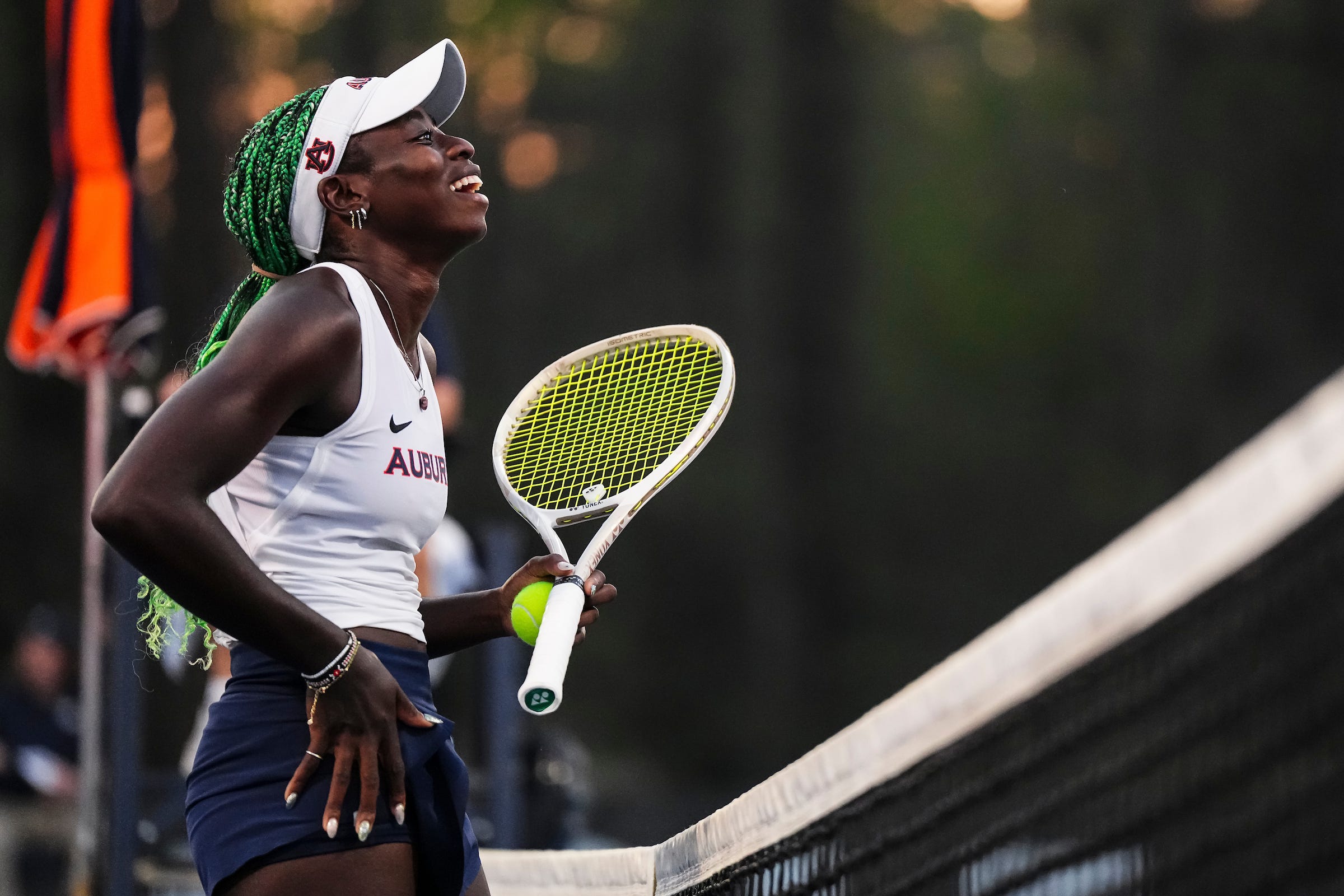
Angella Okutoyi put together a strategic masterclass.
It was a sensational comeback: Down 1-4 in the second set with Auburn’s season hanging in the balance, Okutoyi completely reversed course in an all-timer for Auburn women’s tennis — lifting Auburn to its win last Friday in the Sweet Sixteen over Duke. She hit her spots, she swung with ambition, rising to the occasion instead of shying from the moment, and, perhaps most impressively of all, she adjusted — downloading her opponent, discovering a weakness, and attacking it.
Even though she dropped the first set and trailed well into the second, she found her advantage as the match wore on. A pro in the making, a fourth-year senior for the Tigers who this past offseason celebrated ITF circuit tournament wins in her hometown of Nairobi, Kenya, Okutoyi saw that her conditioning was holding up better than her opponent’s, and started elongating each point.
Each rally wasn’t just about winning that particular point. It was about the long game — about wearing down her opponent for the long haul. It was a pro’s mindset. “I feel like just changing my mindset to playing longer points, and just putting all the balls on the court, and making her work for the point, really changed the match,” she explained. Auburn head coach Jordan Szabo put it this way: “She’s really fit. She’s in great shape. She’s a professional. … Her opponent kinda started breaking down a little bit and Angie seized the moment, played the big points really well.”
She came back to win the second set 7-5, then won the third set with a bagel 6-0. Her victory clinched the match for Auburn 4-2, and lifted Auburn to its first Sweet Sixteen win in program history. Auburn makes its first-ever appearance at the final NCAA Championship site this Friday at 9 a.m. when Auburn rematches LSU in the NCAA Tournament quarterfinals.
Okutoyi punched the ticket. She pulled off the comeback. She did it.
And she did it not just for herself, but for Auburn.
“Auburn means a lot to me,” Okutoyi said, speaking a weekend earlier and standing on the outdoor courts at Yarbrough Tennis Center after Auburn’s second-round win over Miami. “I’ve been here four years and this is my last year, as you all know. So I really want to do good for the school.”
Read it again: “Auburn means a lot to me.” Her plan now is to give back — to again, act not just for herself, but for Auburn — by helping to lead her team to as good of a run as she can, in order to leave something for future Auburn women’s tennis players to build on, to look up, to strive for, to chase after and try to surpass.
“I just feel like we need a legacy, especially in tennis, at Auburn, because I feel like we never had people to look up to, especially from when I came here,” she said then. “I didn’t have someone to look up to from Auburn, like, ‘Oh they did this and that.’ So it would mean a lot if we left a legacy and if people coming after us would see that and want to do more. It would be like a motivation for them.”
Maybe Auburn could benefit from more players, in every sport, like Okutoyi, with her having that mentality and that mindset.
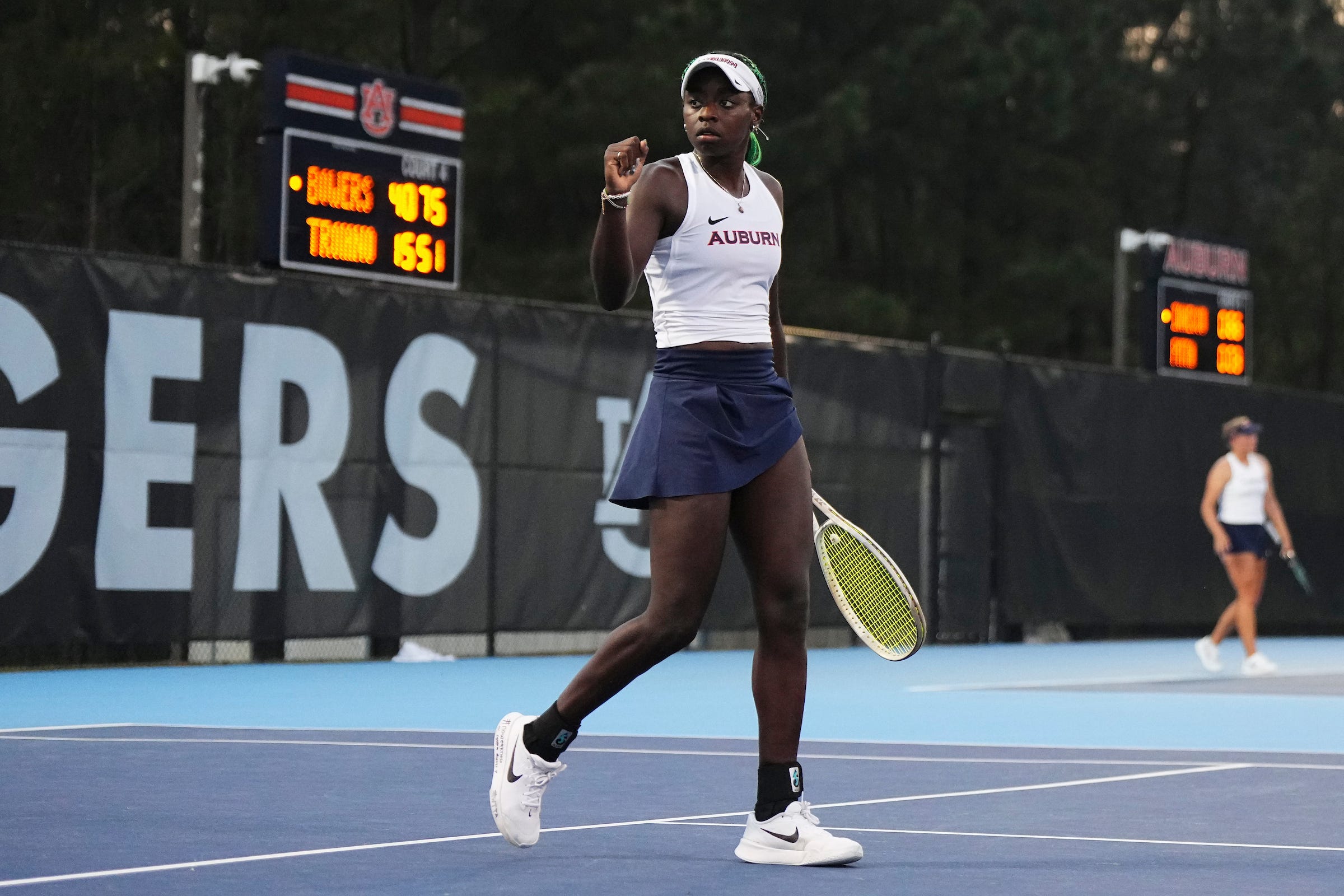
In any event, it’s jarring to hear those quotes, and to hear the way she talks about her school, and in the next moment to think there are people out there who are calling for there to be less people like Okutoyi in college tennis.
Some of those people are just grifting, but some of them are people with real vested interest in tennis. One of the latter is Patrick McEnroe, who has recently called for a cap in the NCAA on how many international players college tennis teams can have on their roster.
His call comes — however convenient the timing may be — after Arkansas announced it’s cutting its tennis program. Saint Louis, North Dakota and Illinois State all made the same announcement around the same time, following Gardner-Webb which had already announced this would be its last year of men’s and women’s tennis.
McEnroe argues that, anecdotally, he’s known parents who’ve stopped investing in tennis for their kids because they’ve been turned off by the idea that they could put a bunch of work in to become a college-level player just for their spot to be taken by a player from another country.
Ignoring the notion that the better player deserves the spot more anyway, McEnroe also hasn’t produced any evidence to suggest that youth tennis signups are down — or, most certainly, any evidence that suggests that any hypothetical downturn in youth tennis signups would be linked for any reason to the percentage of international players on college rosters. Does a white kid stop playing basketball because he’s watched the NBA?
Still, besides McEnroe, more neutral parties also tie that percentage of international players to programs being cut, however loosely. Money-follower Matt Brown of Extra Points listed to Whole Hog Sports a few reasons why tennis, of all sports, may be the most “endangered” to athletics departments looking to make cuts. To paraphrase:
The rosters are relatively small. Cutting the program doesn’t affect Title IX obligations or total athlete enrollment as much as cutting track or swimming, which have much larger rosters. Simple math also says you’re upsetting and disenfranchising a smaller number of former athletes by cutting the sport that has the smallest rosters and the smallest amount of alums.
There are a lot of international players in tennis. Schools may find that international alumni are less visible on campus, less engaged, and may give back less after moving back overseas. The fear is that when their college is out of their sight, it’s out of their mind. Anecdotally, there’s also some non-zero degree of sociopolitical pressure out there from individuals who’d rather see scholarships go to Americans or to local athletes, rather than on merit.
The best tennis players are skipping college and going pro. That brings less visibility to college tennis. In women’s basketball, for example, no one is skipping straight to the WNBA and players recently have found playing in college more lucrative.
Right there among his reasons is that high number of international players.
Make no mistake, and don’t over-think it: The reason sports are being cut at all indeed goes back to football — or, the investments made into football that turned sour and didn’t yield a return. If everyone was getting every dollar they spent on football back, they wouldn’t be cutting anything. It’d be the old way of doing things, plus a bonus. In the “traditional model” — which is what Arkansas called it in its announcement it was cutting tennis — tennis and Olympic sports were never intended to draw revenue. The teams are advertisements — and the return on investment came via enrollment and tuition. Do a significant number of kids enroll at Arkansas just to watch tennis? No. But does anyone buy a Ford truck because of one particular Ford truck commercial they watched? It’s about putting the brand name into the ether — and about being a university that has it all, and not just a university that has some of the stuff its competitors have. That’s still the whole point, “traditional model” or new, and the only difference now is that schools are allowed to spend even more on football than before, and so when they misspend without getting a return, they have to find that lost money elsewhere in the department.
But suppose it’s an inevitability that a sports team has to get cut, and suppose it’s only a matter of which one: A cap on the number of international players allowed might put a Band-Aid on bullet point No. 2 on the list above — but there would still be two other reasons why tennis would still be the most endangered sport in a given athletics department.
Even beyond that, Auburn’s players are proving that second point to be a flimsy reason already.
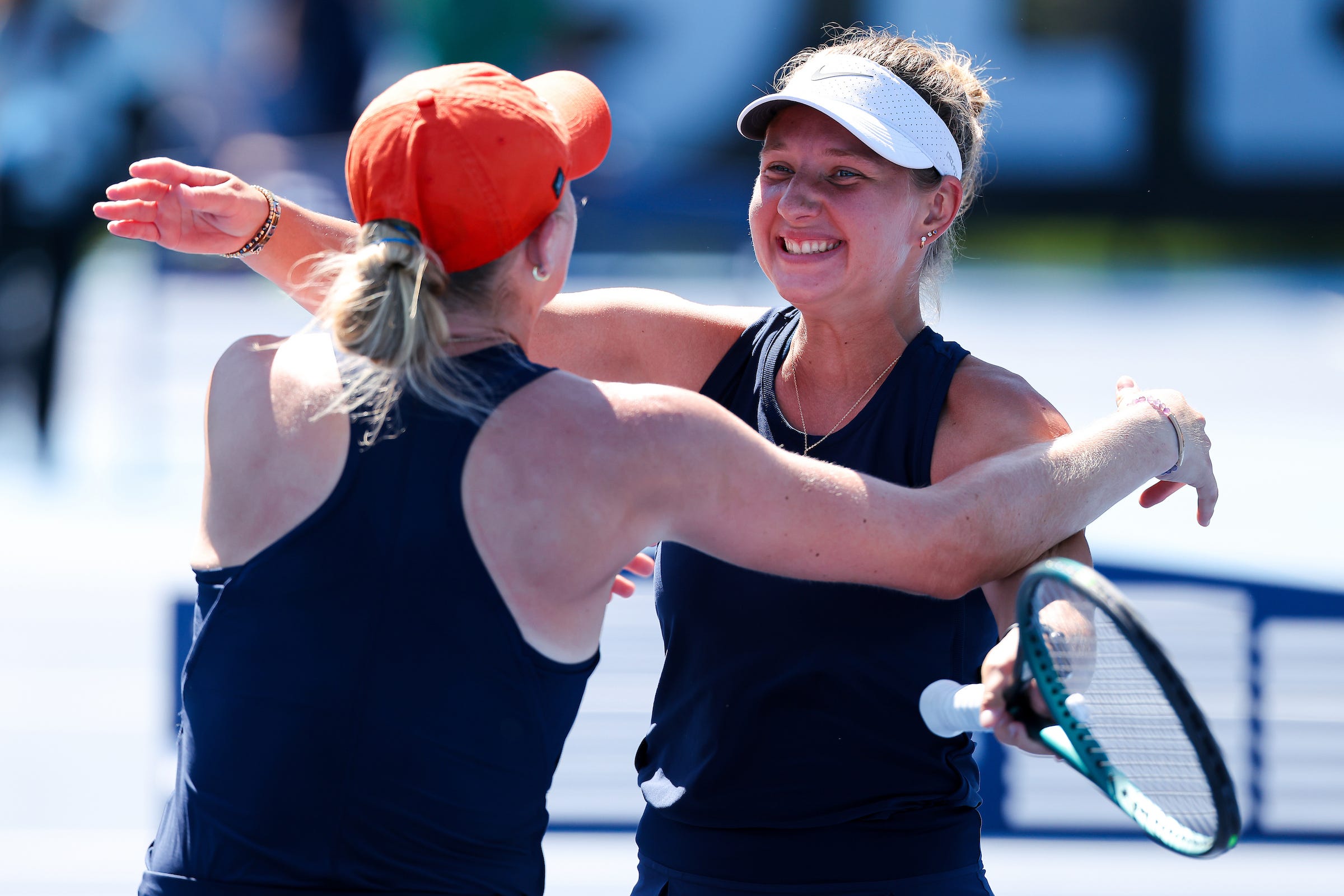
Auburn’s senior transfer Ekaterina Khairutdinova won her match 6-2, 6-1 against Duke, logging another point for Auburn on the singles court, and she said the win “means a lot” — but, again, not just because she wanted the win for herself, but because she wanted the win for Auburn:
“Unfortunately this is my last tournament as an Auburn Tiger, and I just want to do my best and give everything I have left for this team, for this program, for the coaches and for the girls obviously,” she said.
That doesn’t sound like the kind of player any team needs any less of.
In fact, it’s not the kind of player any sport needs any less of.
It’s not the kind of kid these universities need any less of.
Editor’s note from Justin
I haven’t asked any players or Auburn head coach Jordan Szabo about Arkansas cutting tennis or about McEnroe’s proposal. It doesn’t seem appropriate or a good use of interview time in the midst of a team’s tournament run. It’s more a topic for the offseason. The appreciation Okutoyi and Khairutdinova showed for Auburn came up outside of that context.
Justin, this is 🔥🔥🔥. Keep it up.
I hate to say this, but: "fewer."