

With top-10 times in two events, Auburn’s Israel Okon accomplishes even more off the track
Entering the NCAA Preliminaries, Auburn’s Israel Okon is a favorite to qualify for nationals. The hard work he’s put in has paid off for him — and his family. “Track and field has done a lot for me.”

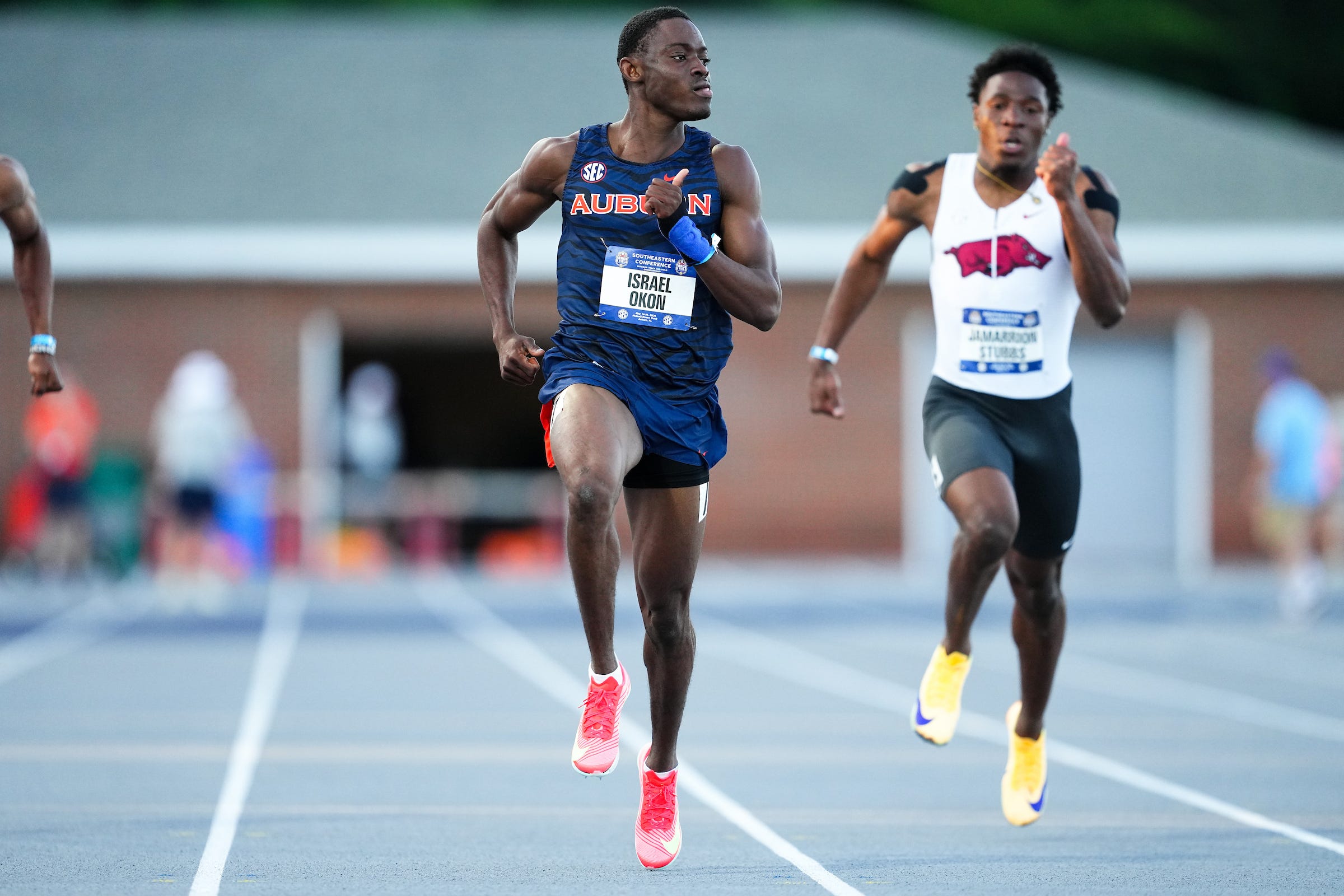
Israel Okon remembers the moment he got his first track spikes, when he was younger.
It was his dad who got them for him, when Okon was growing up in rural Nigeria, and gave them to him. Okon laughs about it now: At the time, he didn’t know they were for track. He thought they were soccer cleats.
“I thought it was a boot, like football,” he laughed. But now that track has become his career, taking him to the Olympics and around the world to Auburn, Okon figures it’s pretty special that his dad was the person who gave him his first spikes, and he enjoys looking back on that fact.
Okon has since poured into track and grown into a top collegiate sprinter — a sophomore at Auburn with top-10 times nationally in Division I in both the 100-meter dash and the 200-meter dash. He could advance to nationals in both events during the NCAA East Preliminaries starting today in Lexington, Ky. — but he’s put a primary focus on the 200 this season. That decision could help Auburn score more points at the NCAA Championships, and help make him even more valuable to the Nigerian National Team in the future, and he says the hard work he’s put into the 200-meter race has also helped him already in the 100-meter race.
It’s no easy task to make that sacrifice and to run two events — but with as much work as Okon has put into track, track has also been able to give back to Okon and his family.
Since coming to Auburn, Okon has been able to buy his parents a house back in Nigeria.
“Track and field has done a lot for me,” Okon said, speaking last week outside Auburn’s track facility. “It’s done very, very big things for me.”
Nigeria to Auburn
Okon continues a strong pipeline of sprinters to come from Nigeria to Auburn, and to work with Auburn sprints coach Ken Harnden.
Before Okon, there’s Auburn junior Kayinsola Ajayi, the indoor national champion this season. Before Ajayi, there was Favour Ashe, who was SEC indoor champion in his time at Auburn.
Like Okon, they both played soccer too, before getting out on the track.
“In Nigeria, everybody’s a soccer guy,” Okon smiled, standing outside Auburn’s track facility last week, just a few days removed from the SEC Championships. Okon won bronze in the 200-meter at the SEC meet.
But back then, Okon said he had actually given up track for about a year of his youth, before his local coach in Nigeria, Oputah Nevin, encouraged to pick it back up.
“He was trying to tell me that I should try to focus,” Okon said. “I stopped track and field for one year because my ex-coach was telling me I didn’t have any future in track. Then Nevin came into the picture and he told me that I should get up and work harder, because he’d seen goodness in me, that I should try my best. I was trying to put in the good work, and he also was trying to teach me some good things. I was progressing.”
While Ajayi competed for the state of Lagos, home to Nigeria’s most populous city of Lagos, Okon represented his more rural home state of Delta. Back before they both made the Nigerian National Team for the Olympics in 2024, and before Okon won the Nigerian national championship in the 100-meter in 2025, Ajayi was telling Harnden about Okon.
“When (Ajayi) came (to Auburn), he was like, ‘Look, I’ve got this guy Israel, and you’ve got to get him,’” Harnden said. “It was true word-of-mouth. And I think it speaks to the type of people in the group, because they want people like themselves. I hate to quote Nick Saban,” Harnden smiled, while wearing his Auburn gear, “but, ‘High-achieving people like to be around high-achieving people.’”
Harnden said that, as much as a good recommendation is about athletes knowing who’s fast, it was even more about Ajayi knowing Okon would fit well and work hard in the collegiate system, value his education, and be up for the challenge of moving halfway around the world to come to Auburn.
The rest, of course, was all Okon.

“When you talk to him on the phone, you could tell he was just a good kid,” Harnden said. “Like, just a nice young man, wanted to do really well, was ready to work hard, ‘Yes sir, no sir, whatever you tell me to do I’ll do it, I’ll figure it out.’
“But, super special kid,” he added, of Okon. “Talented in so many, so many ways. Just freakishly explosive, very different from Ajayi. Ajayi’s very much a strength runner and Israel’s very much what we would call a twitch runner. He’s just got this ability to move the body in ways a lot of people don’t. Like if you watch a football player and you see the wide receiver that can stop on a dime and change direction, that’s Israel.”
Sending back
Harnden, who is originally from Zimbabwe, said that back during his competition career — which led him to the Olympics in 1996 and 2000 — he invested what he earned into real estate, and that he’s been in that space since then.
With some of Harnden’s assistance with the logistics, Okon has been able to build his family a house in Nigeria.
“He saves his Alston money, his cost-of-attendance, he got a little bit of NIL — he builds his parents a house,” Harnden said. “They’d never owned a house before. He put solar panels on the roof. They have the only house in his town with electricity.”
Not only that: They’ve decided to buy two lots down the same street, with plans to build more, to try to create a long-term income generator for the family. In the current world economy, the USD goes a long way in rural Nigeria, and Harnden advises his athletes to try to make their money stretch even further with long-term thinking.
Next, while there’s no pro league of track and field like the NFL or NBA, the goal for Auburn’s athletes is to get professional contracts from apparel companies when they leave the Plains.
“When you talk about a $150-250,000 contract, and what that does not just for mom and dad, and my brother and my sister, and cousins and aunties and uncles and everybody else — it changes people’s lives, right?” Harnden said. “Then there’s the second step of that. Everybody’s like, ‘OK, we’ll get them to be a pro and they’ll go make money.’ But then it’s, ‘Well, track and field isn’t the NBA. I’m not going to make $100 million and live on it forever.’ So, how do we teach them to do things a different way?”
For now — while the Los Angeles Olympics in 2028 loom — it’s about putting a best foot forward at the NCAA Championships starting June 8 in Eugen, Ore.
“Ken is a good coach to me,” Okon said. “He treats me like his own son. He makes sure I do my things. Apart from track and field, in terms of school, he always wants me to make sure I put in my good work in school, like class, take notes and everything. And he doesn’t want me to go to class late. Sometimes he always texts me, ‘Where are you? Are you in class?’ I say, ‘Yes, I’m in class,’” Okon laughed.
The road to the NCAA Championships
Since taking on Harnden’s plan to focus on the 200-meter, Okon said he’s gotten faster even in the 100-meter.
“It’s helping me all around,” he said.
Yes indeed: Okon has only run the 100-meter one time all season in 2026, at the Tom Jones Memorial at Florida on April 18, and there he ran a 9.95 — a faster time than all but one of his 18 races last year in the 100-meter.
It’s also the seventh-best time run so far this season in Division I.
In the 200-meter, he has DI’s sixth-best time.
With Ajayi on Auburn’s roster and a national contender in the 100-meter, letting Okon loose on the 200-meter reduces some redundancy for Auburn as it tries to score as much as possible at the NCAA meet — and, as Okon said, has made him a better all-around sprinter at the same time. Okon said that while the 100-meter is one race, the 200-meter is really two races: The curved portion, and the straightaway portion. Becoming more adept on curves could also make Okon even more valuable both to Auburn and Nigeria as a relay option.
“I have a feeling that I’m going to be great, as long as I’m training with Coach Ken,” Okon said.
Starting today, Okon and the rest of Auburn’s men’s team begins competition at the NCAA East Preliminary in Lexington, with eyes on qualifying for the national meet. In total, 48 athletes from each event are being brought to Lexington with the meet designed to taper the group down to 12 qualifiers for the NCAA Championship meet in Eugene. For the sprinters, there are first-round heats Wednesday, with advancing runners moving to the quarterfinal races on Friday — from which 12 qualifiers will earn their spots at NCAAs. The women compete at the preliminary on Thursday and Saturday.
Appreciate these Tigers!